

Special to North Carolina Construction News
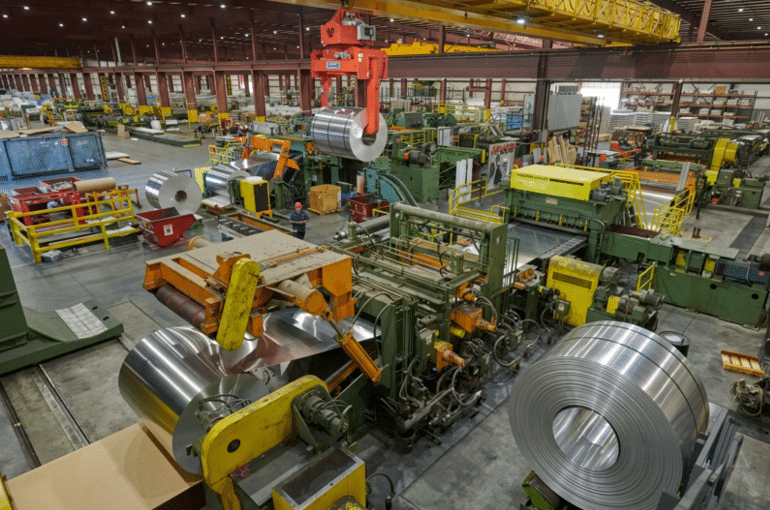
North Carolina’s HVAC manufacturing sector is in the middle of a hiring and construction surge. The equipment coming out of those expanding plants needs sheet aluminum processed to tolerances tighter than standard mill coils can reliably deliver.
As heating and cooling systems are engineered to meet stricter energy-efficiency benchmarks, the margin for variance in the metal itself keeps shrinking. That shift is reshaping how manufacturers source and process their raw material.
A wave of investment in the Triad
Environmental Air Systems, a volumetric modular manufacturer of HVAC infrastructure and a subsidiary of Comfort Systems USA, announced it will invest approximately $20 million to open a new subassembly production operation in Asheboro. The move will create 300 jobs in Randolph County.
The company has operated in the Triad region since 1953. It will use the new 300,000-square-foot Asheboro facility to produce subassemblies for mission-critical, pharmaceutical, data center, semiconductor and healthcare customers.
Gov. Josh Stein credited the project to the strength of the state’s manufacturing workforce and said it would strengthen North Carolina’s advanced manufacturing base. Allen Absher, president of EAS Manufacturing, said the company has built relationships in the state for more than 70 years, and that the expansion positions it to take on more complex projects while adding local jobs. The project is also tied to a 12-year Job Development Investment Grant that state officials expect will add more than $700 million to the state’s economy over its lifetime.
A month later, the state announced a second major HVAC investment into Hoffman & Hoffman, an employee-owned supplier of commercial HVAC systems based in Greensboro. The company plans to spend $40 million consolidating operations into a single Guilford County location and add 131 jobs over the next five years.
“The Hoffman family of companies continues to grow because our employee-owners never lose sight of the people we serve,” said Jim Bingham, chief executive of Hoffman & Hoffman. “When we put our customers at the center of every decision, success follows.” North Carolina Commerce Secretary Lee Lilley said manufacturers need a stable business climate to succeed, and that the state remains committed to supporting Hoffman & Hoffman’s next phase of growth.
Why Tolerances Are Tightening
As HVAC systems have grown more sophisticated to meet rising energy-efficiency standards, the sheet metal used in coils, housings and structural components has to hold shape with far less variance than older equipment required.
A component with inconsistent thickness or flatness creates problems on the production line:
- Disrupted airflow through the finished unit
- Gaps that reduce sealing efficiency
- Complications during precision welding and forming
The Sheet Metal and Air Conditioning Contractors’ National Association publishes duct construction and installation standards that assume dimensionally consistent sheet metal inputs. Manufacturers must maintain consistent material dimensions because duct sections, housings and formed components must fit together predictably during fabrication and assembly.
ASHRAE maintains a similar set of performance and testing guidelines for HVAC equipment efficiency. Dimensionally consistent material makes it easier for manufacturers to meet system-level requirements.
Meeting the spec through precision processing
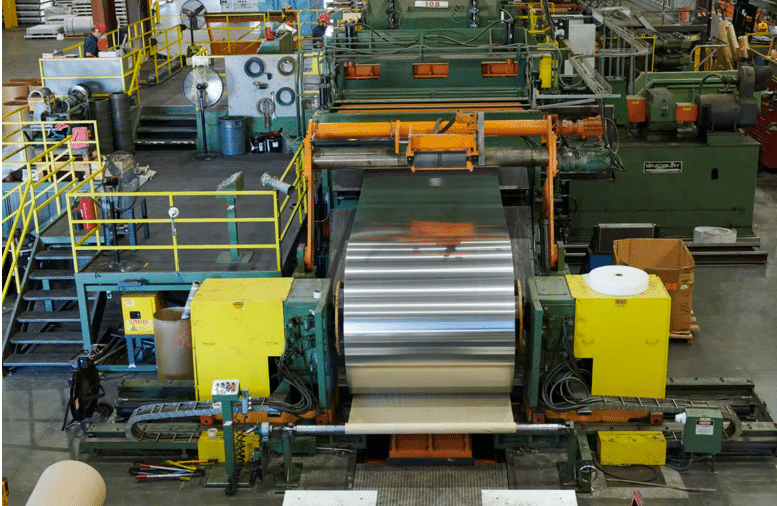
Standard mill coils are not manufactured to the flatness and gauge consistency that today’s HVAC components demand. That gap has pushed manufacturers toward toll processors that specialize in reworking coil stock to tighter specifications before it reaches the production floor.
For manufacturers processing oversized components, such as ductwork sections that can run 40 feet or longer, specialized processing equipment is necessary. Processes like tension leveling and precision cut-to-length remove the crown and edgewise curvature that raw mill coil can carry, delivering flatter material with tighter dimensional consistency.
Not every processor is equipped to handle the widest coil widths or the longest cut-to-length runs. Champagne Metals, an Oklahoma-based processor with facilities across North America, handles coil-to-coil processing up to 108 inches wide and cut-to-length processing for gauges as thin as 0.010 inches and lengths exceeding 650 inches. For North Carolina HVAC manufacturers ramping up new production lines, outsourcing to regional processors with that equipment can be faster than installing and qualifying leveling and slitting systems internally.
Part of a larger efficiency push
The demand for tighter tolerances in HVAC manufacturing tracks with a broader trend in construction and building performance. Builders and equipment makers are responding to similar pressure.
The International Energy Agency reported that global energy demand grew by 2.2% in 2024, putting efficiency gains further into focus across construction and manufacturing. For HVAC manufacturers, that broader push reinforces the same tolerance requirements already shaping their production lines.
What comes next
Both North Carolina projects carry multiyear timelines. The Hoffman & Hoffman expansion is expected to unfold over the next five years as the company consolidates its Guilford County operations. Meanwhile, the Environmental Air Systems project will ramp up in Asheboro under the terms of its state grant agreement.
As both facilities come online, demand for precision-processed aluminum coil is expected to grow alongside them, reinforcing the role of specialized toll processing in North Carolina’s expanding HVAC manufacturing footprint.